
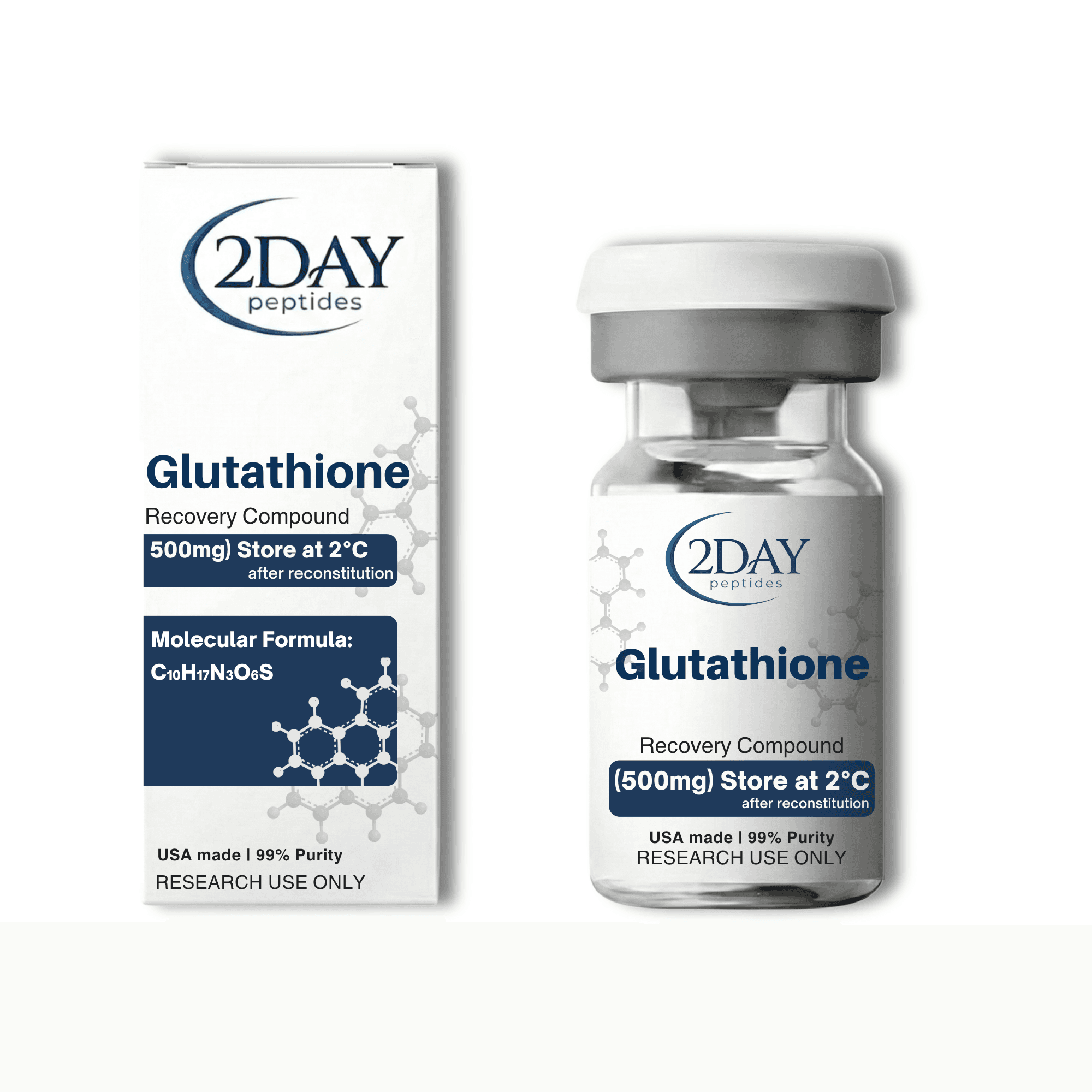
L-Glutathione
Technical Specifications
Select Size
L-Glutathione
We're making the next batch
Ships in ~7 days or less
Research Use Only
These products are for laboratory research only and not intended for medical use. They must be handled by qualified professionals in controlled laboratory environments. This compound has not been evaluated by the FDA and is not approved for human or veterinary use.
L-Glutathione FAQ
L-Glutathione (GSH) is a tripeptide composed of glutamate, cysteine, and glycine, with an unusual γ-peptide bond between the glutamate and cysteine residues. It is the most abundant low-molecular-weight thiol in animal cells (typically 1–10 mM intracellularly) and is the central molecule in the cellular antioxidant defense and phase-II detoxification systems. Research investigations span redox biology, hepatology, neuroscience, and dermatology.
Reduced glutathione (GSH) has a free cysteine thiol (–SH) and is the redox-active form that neutralizes oxidants. When GSH donates electrons, two molecules join via a disulfide bond to form oxidized glutathione (GSSG). The intracellular GSH:GSSG ratio is typically >100:1 in healthy cells and drops under oxidative stress, making it a standard biomarker in redox research. Glutathione reductase regenerates GSH from GSSG using NADPH.
N-acetylcysteine (NAC) is a precursor that supplies cysteine — the rate-limiting amino acid for GSH biosynthesis — but is not itself glutathione. Research has used NAC to elevate intracellular GSH levels indirectly, while reduced glutathione (GSH) provides the intact tripeptide directly. Both are common reagents in oxidative-stress research with distinct pharmacokinetic profiles.
Made in the USA
Quality controlled from start to finish. No outsourcing.
Tested
Assured
Grade
L-Glutathione Overview
L-Glutathione (GSH) is a tripeptide of glutamate, cysteine, and glycine found intracellularly. Supplied as a research reagent for in vitro laboratory assays only; not for human or animal use.
L-Glutathione Structure
Sequence:
γ-L-Glu-L-Cys-Gly
Synonyms:
References & Citations
- Pompella A, Visvikis A, Paolicchi A, De Tata V, Casini AF. The changing faces of glutathione, a cellular protagonist. Biochem Pharmacol. 2003;66(8):1499-1503.PMID: 14555227
- Lu SC. Regulation of glutathione synthesis. Mol Aspects Med. 2009;30(1-2):42-59.PMID: 18601945
- Forman HJ, Zhang H, Rinna A. Glutathione: overview of its protective roles, measurement, and biosynthesis. Mol Aspects Med. 2009;30(1-2):1-12.PMID: 18796312
- Sechi G, Deledda MG, Bua G, Satta WM, Deiana GA, Pes GM, Rosati G. Reduced intravenous glutathione in the treatment of early Parkinson's disease. Prog Neuropsychopharmacol Biol Psychiatry. 1996;20(7):1159-1170.PMID: 8938817
These references are provided for research purposes only. Citations do not imply endorsement or approval of this product for any specific application.